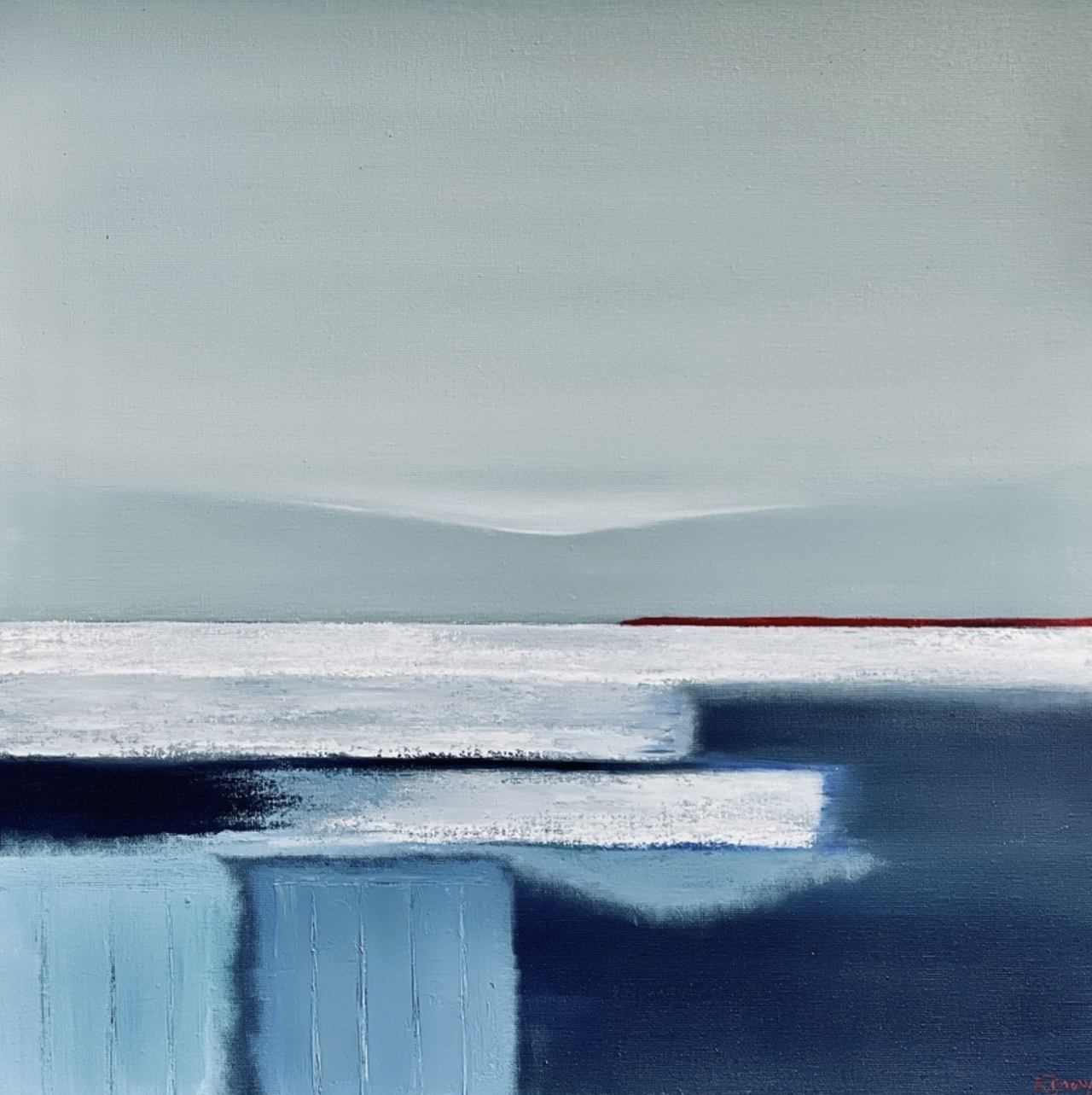
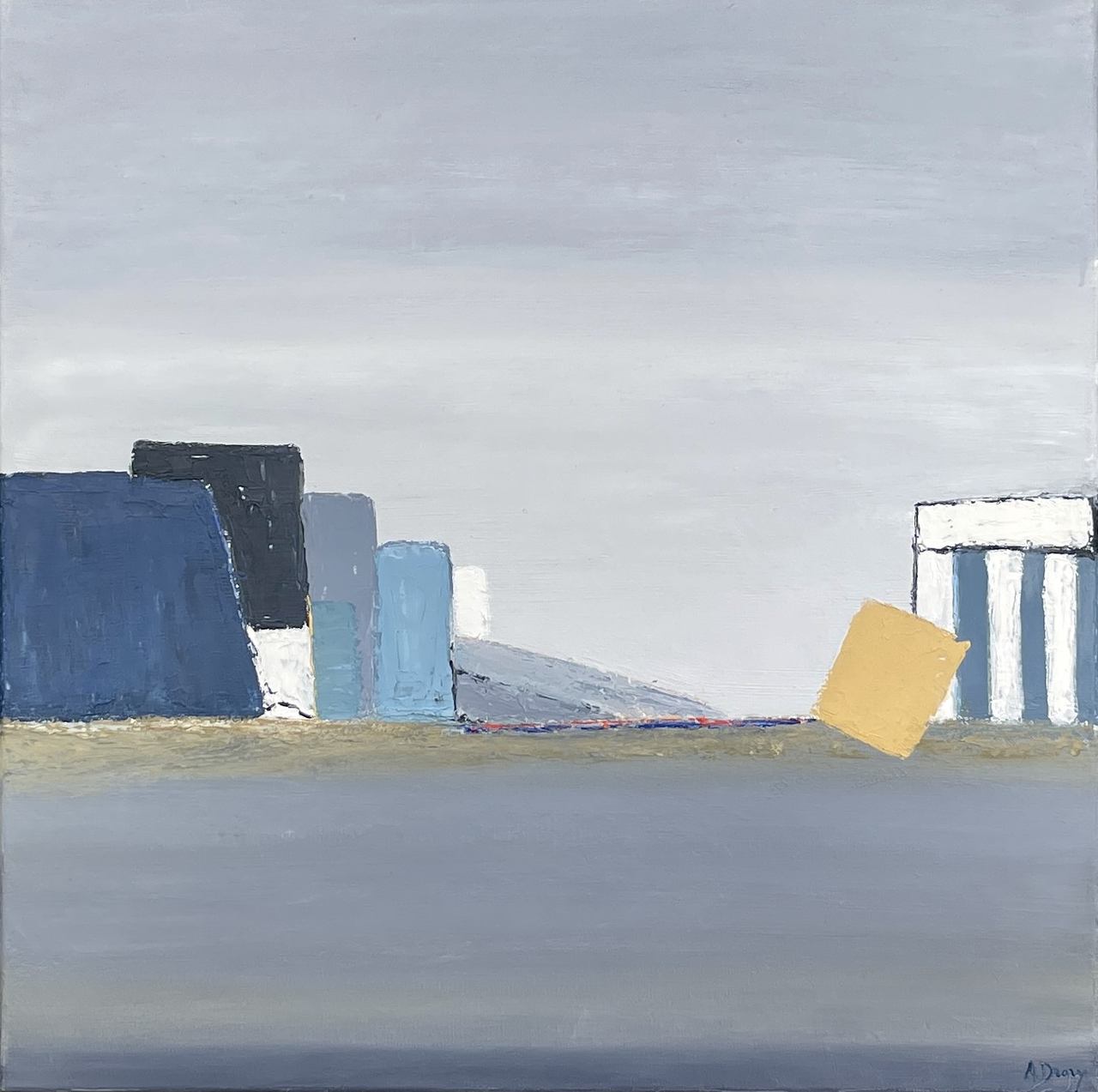
Il y a, dans la peinture d’Annabelle Drory, des lieux et des éléments que nous croyons reconnaître sans jamais pouvoir les situer tout à fait. Une ligne d’horizon, quelques reliefs, des constructions réduites à leurs formes essentielles.
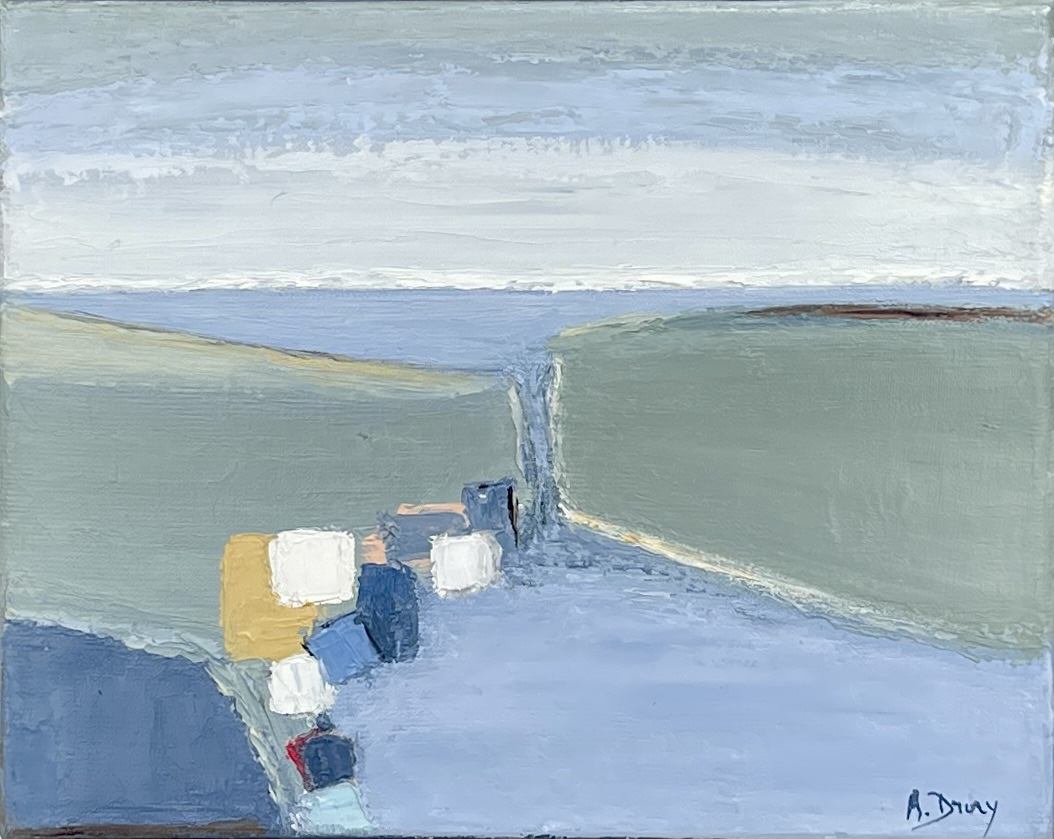
Dans ses tableaux maritimes, le monde visible est soumis à un lent travail d’effacement. Les détails disparaissent, les volumes se simplifient, les architectures deviennent des blocs de couleur. Entre figuration et abstraction, Annabelle Drory ne conduit plus le regard vers un point précis ; il demeure dans l’étendue et suggère.
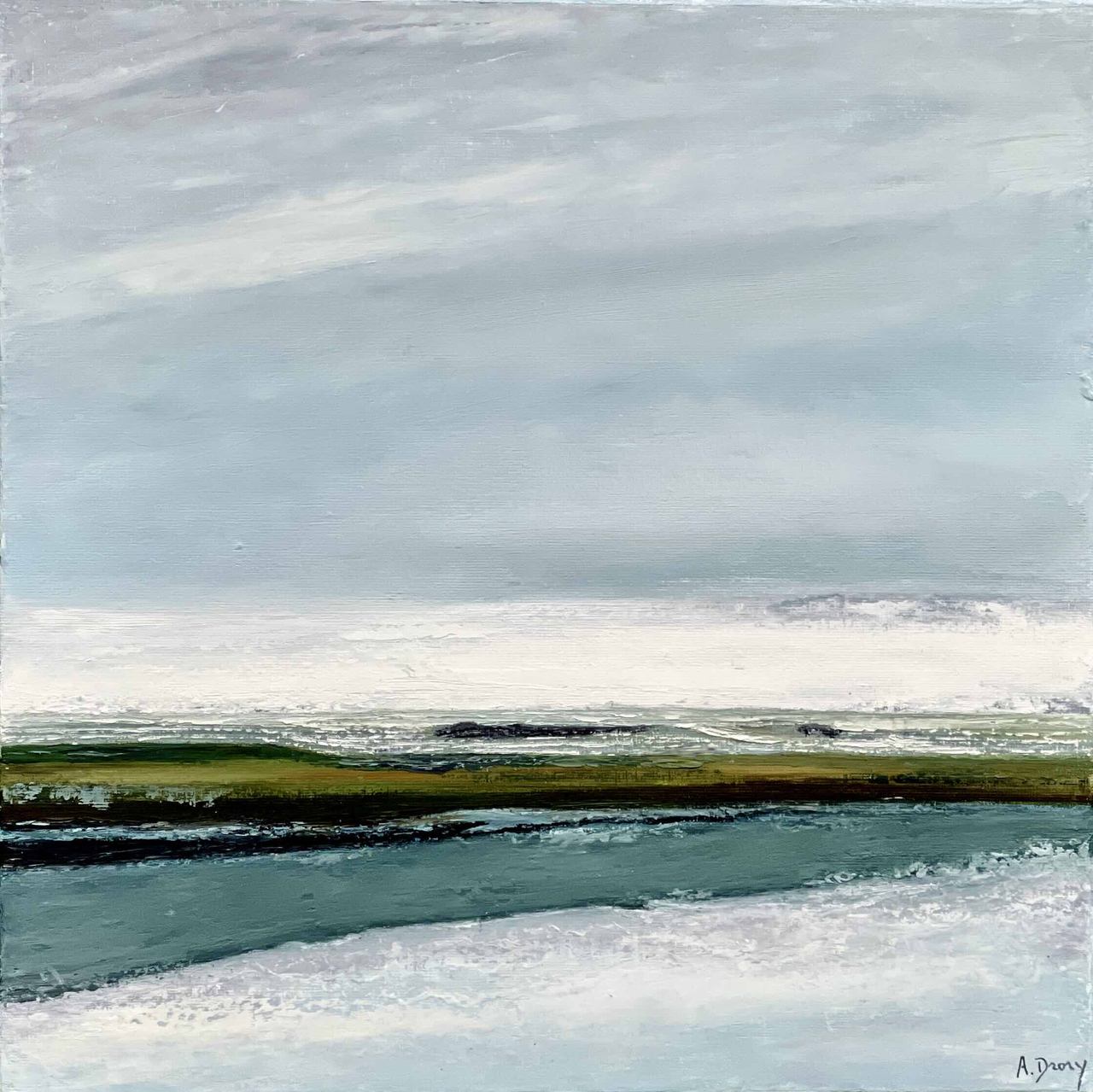
Ses peintures s’organisent souvent autour d’une horizontalité dominante. Le ciel y occupe une place considérable, tandis que la terre, l’eau ou les constructions se resserrent dans la partie inférieure de la toile. Ces proportions donnent au vide une présence presque physique. Le paysage n’est plus le décor d’une action : il devient l’événement lui-même.
La palette, faite de gris bleutés, de vert d’eau, de blancs crayeux et de bleus profonds, restitue l’ambiance particulière du Nord. La lumière ne fixe aucune heure précise. Le paysage paraît saisi dans une durée indéterminée, entre apparition et effacement.
Quelques accents d’ocre, de rouge ou de noir interrompent la continuité chromatique et introduisent une tension dans l’horizontalité. Ces formes isolées apportent au paysage une présence énigmatique, parfois presque narrative. Un simple rivage peut basculer presque imperceptiblement dans l’abstraction.
Ces peintures marines d’Annabelle Drory me font penser à Marguerite Duras. Elle partage avec son écriture un même usage du silence, de l’attente et de l’absence. Ici aussi, le paysage paraît attendre. Quelque chose s’est retiré, mais demeure perceptible. Et ce silence est parfois parlant.
Le sujet profond de cette peinture maritime n’est peut-être pas tant le paysage que le seuil : la limite entre ciel et terre, présence et disparition, le dit et le non-dit, figuration et abstraction.
Dans l’ensemble, Annabelle Drory peint moins la réalité exacte d’un lieu que la mémoire que nous pouvons en conserver ou le sens que nous sommes libres de lui donner. Il en émane une atmosphère méditative, légèrement mélancolique, où le vide joue un rôle aussi important que les éléments représentés.
Dans ses œuvres abstraites, Annabelle Drory ne cherche plus tant à représenter un lieu qu’à faire advenir un espace. La peinture s’affranchit progressivement du paysage observable pour construire son propre territoire, composé de masses colorées, de lignes, de fragments et de traces. Si l’horizon demeure parfois perceptible, il n’est plus la description d’une étendue précise : il devient un principe d’organisation, un prétexte à communiquer son ressenti.
Annabelle Drory travaille dans un équilibre constant entre construction et intuition. La spatule dépose la couleur, mais peut aussi la retirer, la déplacer ou l’éroder. Le tableau se construit par une succession de décisions, d’observations et de réponses apportées à ce qui survient sur la toile. Les reprises, les transparences et les accidents ne sont pas dissimulés : ils participent pleinement à l’image et lui donnent sa profondeur.
Le vide joue ici aussi un rôle essentiel : il n’est pas un fond passif, mais un espace actif qui permet aux formes de respirer et détermine leur intensité.
Cette manière de procéder produit une abstraction qui ne rompt jamais complètement avec le monde sensible. Le paysage n’est donc pas absent : il a été intériorisé. Il subsiste à l’état de sensation, de rythme et de mémoire, il suggère un message sans le formuler. Il est offert à l’interprétation et à l’imagination du spectateur.
Parfois, la composition se fragmente davantage. Des lignes interrompues et des surfaces partiellement recouvertes instaurent une perception discontinue. L’œil circule sans pouvoir reconstituer une image unique. La ligne elle-même semble hésiter entre contour, écriture et trajectoire. Comme chez Paul Klee, elle peut être envisagée comme un mouvement avant d’être une délimitation : elle traverse l’espace, ouvre un passage et suggère encore.
Le travail d’Annabelle Drory se situe ainsi dans un espace intermédiaire : entre le visible et l’invisible, la préméditation et l’accident, la stabilité et la disparition, le dit et le non-dit.
Ses tableaux ne livrent pas une image arrêtée. Ils donnent à voir un processus au cours duquel les formes émergent, se transforment et demeurent toujours susceptibles de s’effacer.
Leur force tient à cette disponibilité. Rien n’y est imposé, mais rien n’est laissé au hasard. La peinture propose des seuils et des directions que chacun peut investir librement. Elle ne représente plus le monde : elle en retient certaines expériences fondamentales — la lumière, la distance, le passage du temps, les aléas de l’existence, la persistance fragile des choses — pour les recomposer dans un langage devenu pleinement pictural.
In Annabelle Drory’s paintings, there are places and elements we think we recognise, yet can never quite locate. A horizon line, a few contours, buildings reduced to their essential forms.
In her seascapes, the visible world undergoes a gradual process of erasure. Details disappear, volumes become simpler, and buildings turn into blocks of colour. Moving between figuration and abstraction, Annabelle Drory no longer directs the eye towards a particular point; it remains within the expanse, where the painting leaves room for suggestion.
Her paintings are often organised around a dominant horizontal line. The sky occupies a considerable space, while land, water or buildings are compressed into the lower part of the canvas. These proportions give emptiness an almost physical presence. The landscape is no longer the setting for an event: it becomes the event itself.
Her palette of blue-greys, sea greens, chalky whites and deep blues evokes the distinctive atmosphere of the North. The light belongs to no particular hour. The landscape seems suspended in an undefined stretch of time, between appearance and disappearance.
Touches of ochre, red or black interrupt the continuity of colour and introduce a tension into the horizontal composition. These isolated forms lend the landscape an enigmatic, at times almost narrative presence. A simple shoreline can shift almost imperceptibly into abstraction.
Annabelle Drory’s seascapes remind me of Marguerite Duras. They share with her writing an attentiveness to silence, waiting and absence. Here, too, the landscape seems to be waiting. Something has withdrawn, yet remains perceptible. And this silence can sometimes speak volumes.
The deeper subject of these seascapes may be less the landscape itself than the threshold: the boundary between sky and land, presence and disappearance, what is said and what remains unsaid, figuration and abstraction.
Taken as a whole, Annabelle Drory’s paintings depict less the precise reality of a place than the memory we retain of it, or the meaning we are free to give it. They convey a meditative, faintly melancholic atmosphere in which empty space matters as much as the elements represented.
In her abstract works, Annabelle Drory is less concerned with depicting a place than with bringing a space into being. Her painting gradually frees itself from the observable landscape to establish a territory of its own, made up of fields of colour, lines, fragments and traces. If a horizon can sometimes still be discerned, it no longer describes a particular expanse: it becomes an organising principle, a means of conveying what she feels.
Annabelle Drory works in a constant balance between construction and intuition. The palette knife lays down colour, but can also remove, shift or erode it. Each painting develops through a succession of decisions, observations and responses to what happens on the canvas. Reworked passages, transparencies and chance effects are not concealed: they become integral to the image and give it depth.
Here, too, empty space plays an essential role. It is not a passive background but an active space that allows forms to breathe and determines their intensity.
This approach produces an abstraction that never entirely breaks with the sensory world. The landscape is therefore not absent: it has been internalised. It persists as sensation, rhythm and memory, suggesting something without stating it. It is open to the viewer’s interpretation and imagination.
At times, the composition becomes more fragmented. Broken lines and partly covered surfaces create a discontinuous perception. The eye moves across the painting without being able to reconstruct a single image. The line itself seems to waver between contour, writing and trajectory. As in the work of Paul Klee, it can be understood as movement before it becomes a boundary: it crosses space, opens a passage and continues to suggest.
Annabelle Drory’s work thus occupies an in-between space: between the visible and the invisible, intention and chance, stability and disappearance, what is said and what remains unsaid.
Her paintings offer no fixed image. They reveal a process in which forms emerge, change and always remain capable of fading away.
Their strength lies in this openness. Nothing is imposed, yet nothing is left to chance. The paintings offer thresholds and directions that each viewer is free to explore. They no longer represent the world; they retain certain fundamental experiences of it — light, distance, the passage of time, the contingencies of life, the fragile persistence of things — and recompose them in a language that is wholly painterly.
Après avoir exercé de nombreuses années comme avocate au barreau de Bruxelles, avoir approché l’architecture, l’immobilier et enfin la promotion théâtrale, le parcours photographique et pictural d’Annabelle Drory est, quant à lui, celui d’une autodidacte !
Être autodidacte, c’est le chemin de la liberté. Qui permet aussi de faire primer la spontanéité sur le savoir.
Elle a toujours été fascinée par la mer, sa ligne d’horizon, ses lumières, son bruit, ses vagues, ses couleurs changeantes et ses perspectives.
« Les mers, et principalement celles du Nord, sont des espaces qui respirent et des lieux porteurs de beauté ; je ressens toujours le profond désir de partager mes émotions au travers de ma peinture, tout en développant ainsi la conscience de mon être au sein de mon environnement. »
Après l’avoir beaucoup photographiée, elle s’approprie aujourd’hui la toile de manière instinctive, avec le souvenir du réel mais avec l’interprétation qu’elle en fait, reflet de sa sensibilité, de son moi intérieur.
After many years as a lawyer at the Brussels Bar, followed by forays into architecture, real estate and, finally, theatre production, Annabelle Drory came to photography and painting entirely self-taught.
To be self-taught is to take the path of freedom — one that also lets spontaneity prevail over knowledge.
She has always been fascinated by the sea: its horizon line, its light, its sound, its waves, its shifting colours and its perspectives.
“The seas, above all those of the North, are spaces that breathe and places that carry beauty; I always feel a deep desire to share my emotions through my painting, while developing an awareness of my own being within my surroundings.”
Having photographed it extensively, she now takes hold of the canvas instinctively, guided by the memory of what is real but also by her own interpretation of it — a reflection of her sensibility, of her inner self.